Saturday, May 4, 2013

Storytelling

Daughter's lament
"Why did you leave him there for five hours? Admitted straight from diabetic clinic to A&E, unwell. Why not straight to a ward instead of hours waiting 'to be clerked'? The tea lady was nice, simple but caring. Her BMI was no example of 'health'. She looked cuddly though, in her ill fitting uniform. She remained oblivious to time-scales and targets. She dutifully, but kindly, offered us tea every hour or so. No one else acknowledged us. 

He is diabetic y'know. He took his insulin at 5pm and was not given any food - hypo ahead. He cannot hold his neck up in this seated position for much longer, he has cervical spondylosis too. You have made him sit on the A&E trolley for 5 hours.
I can see you are busy. He is in too much pain. I can't watch this.

We weighed up the situation. We decided that being at home is better than this, despite his eGFR (kidney function) being in his boots. We walked out of the department. No one noticed....except for the tea lady. You could see the anguish in her face. She felt powerless to do anything, she tried to tell someone...everyone was too busy. 
She was not powerless...her compassion had power."

This incident broke my heart. It was a defining evening in October 2012. I am blessed that my father is still alive, but the realisation that doctors and nurses are too busy to care drove me to want to be part of a solution...not part of the problem. I work for the NHS, I have to take some responsibility for this event.

"The only thing necessary for the triumph [of evil] is for good men to do nothing." (E Burke)

 I realise I have made a big generalisation, apologies to those who strive to hold on to the values that compelled them to work in the "caring" profession.
Earlier this year we were shocked and saddened by the stories of neglect and poor care described in the Francis report. What is happening? Compassion fatigue?

Compassion costs nothing
On the 25th April I attended an RCGP Midland conference called " Compassion in Healthcare". I heard Prof David Haslam speak of a deterioration due to 'task based care' versus 'person centred care'. He spoke of the barriers to compassionate care e.g. busy-ness, lack of continuity, lack of a sense of personal responsibility. He went on to suggest what we could do about it:

  • Value compassion
  • Review criteria for medical school recruitment
  • Value the role of the Generalist
  • Appreciate each other - the way we treat each other matters
Everything he was saying made absolute sense. Interestingly, in a workshop, one doctor said that he has not got time for compassion in the ten minute consultation. I can see where he was coming from as I think he was alluding the the time pressure and being 'busy', but I was not in agreement. Earlier in the week I had an interesting conversation with Kevin Ilsley about the impact one can make in ten minutes. Clinicians are often  not aware that in ten minutes you could change someone's life...by inspiring them, by empowering them, by being kind to them, by offering a solution. On the flip side it takes less than ten minutes to break someone's trust and lose them for life.

Jill Fraser gave a very sincere, high speed talk on the charity Kissing it better. She entertained us with the ridiculous levels of bureaucracy standing in the way of 'greater good'. Admirable and Simple interventions.

The short narrative at the top of this post was written as part of a workshop by Katherine King and Kevin Ilsley. I had never written down the incident before. We were asked to narrate an incidence where compassion was lacking. In writing it down it made me think about how to use words to convey feelings and context. Most of us don't really get the chance to do this kind of thing. 

"For the professionals, storytelling and hearing has some particularly important roles to play in helping us to understand our clients and in helping us to explore our own practice. These stories that we tell and hear, but which, at the same time we are also part of. And we learn early in professional practice, if not early in our life, that there is always more than one version of a story. This, of course can be turned to positive use in trying to understand something through a story. And one of those things that we can learn to understand better is the art of storytelling itself" 
Fish.D 1998 Appreciating Practice in the Caring Professions p154

Stories can be entertaining, shocking, untrue and there is often much to disentangle. De Cossart and Fish - Developing the wise doctor (2011) state that doctors have to make sense of individual accounts of patients or colleagues, in a world of complexity, paradox and ambiguity, above all else, stories:
  • Exist in the particular ( they are about individuals)
  • Highlight the importance of moral enquiry (they show the importance of seeking in the given case what the most opportune action might be)
  • Promote the pursuit of practical reasoning - 'the ability to determine the best action to take in particular circumstances that cannot be distilled into universally applicable solutions'. 
I find the latter point most interesting. De Cossart and Fish cite Montgomery (2006) for the quote. This, to me sounds like Aristotle's concept of Phronesis -  Practical Wisdom.....a subject I am sure to mention again, as it forms the basis of my PhD.

Storytelling need not be in the form we traditionally associate it with. Dr Anne Marie Cunningham (who writes a good blog and is very much engaged in technologies and Medical Education) brought my attention to the potential of digital storytelling and it's ability to help students to reflect. I have to admit that I love watching the RSA Animate videos on YouTube. I had not thought of it as digital storytelling!


One final thing I wanted to mention is Storytelling in Leadership. I am coming across an increasing amount of information referring to the power of the art of storytelling in leadership. There are even courses at top universities e.g "Winning Hearts and Minds - Storytelling for professional managers" - Cranfield Business School. The hyper-links are from Forbes magazine and Harvard Business School, respectively.

I certainly think there is room, for those of us who were pummelled with years of bio-medical and clinical education, to revisit the art of telling, and interpreting tales.

Tell me a fact and I'll learn. Tell me a truth and I'll believe. But tell me a story and it will live in my heart forever. ~ Indian proverb

Saturday, April 20, 2013

On Death and Professionalism

The bubble-blower analogy
During our lives we blow content, in the form of experiences, moments of love and sadness and the mundane in between. If we stop to reflect IN life we see the beauty of the translucence, the perfect curve and the reflected rainbows within the bubble. As the content increases so does the fragility of that bubble. Then it bursts, physically evidence less, into the ether.

Empathy the action of understanding, being aware of, being sensitive to, and vicariously experiencing the feelings, thoughts, and experience of another of either the past or present without having the feelings, thoughts, and experience fully communicated in an objectively explicit manner; also : the capacity for this (Merriam-Webster dictionary)


This is an "unscheduled" blog. I only intended on writing one a week. I have been thinking and reflecting all day. Why? Because this lunchtime we had intended to visit a respected relative/friend/GP who has been incredibly resilient in his battle with cancer. We intended to visit him at lunchtime at his home, but instead we attended his funeral.


  • He was of my generation
  • He has left behind two teenage children and a devoted wife
  • He was a Birmingham GP
This, amongst other factors, made this funeral particularly difficult for me. His father spoke in a broken, weak voice. He pleaded that we pray for his son. These words reverberate in my mind. No parent expects to bury their child. A man who bathed his cherished infant was now washing the body of his son, whose body has been consumed by a parasitic cancer. 
Of course Dr F professionally knew death;

" The doctor is the familiar of death. When we call for a doctor, we are asking him to cure us and relieve our suffering, but, if he cannot cure us, we are also asking him to witness our dying. The value of the witness is that he has seen so many others die...He is the intermediary between us and the multitudinous dead. He belongs to us and he has belonged to them. And the hard but real comfort which they offer through him is still that of fraternity"
Berger J and Mohr J. A Fortunate Man. 1967

But he must have had an entirely different experience being a patient. My curiosity led me to do an Internet search on literature on dying doctors. I found an interesting article in the Guardian.

The sentiment resonates with some books I am reading at the moment. Matters of Life and Death by Iona Heath takes a critical look at the state of medicine today,
" Science does not know when to stop"....and I wholly agree with her in this context.
Dr Heath's book should be essential reading for all GPs. She bravely and sensibly presents eloquent examples from the humanities about death...and what a good death might look like. I hope for a good death, when the time comes. I want my patients to have "good deaths" too. John Berger contributed to Dr Heath's book. He wrote A fortunate man, quoted above. This provides a fascinating insight into the life of a country GP in the 60's in Ireland. This conveys a certain professional wisdom and benevolence that I feel needs to be discussed and explored in modern Med Ed programmes. 

Debilitating empathy - has it ever happened that a doctor has had so much empathy for a patient that they lose the ability to think objectively? It would be considered unprofessional I suspect. So as doctors we put up barriers to protect ourselves. Only by reflection can we tell if we get the balance right. 

Tenuous link to the fact that I have had to read the GMC's new guidance on Good Medical Practice, which "goes live" on Monday 22nd April. The reason I have read this is:
  • I have to, it is my professional duty to do so
  • I am involved in a teaching session on professionalism next week
  • It forms the basis of revalidation
Anyway, whilst  reading it something struck me. Statement 16c says:
  • Take all possible steps to alleviate pain and distress whether or not a cure may be possible
This perturbed me as I had only just read, and agreed with page 37 of Iona Heath's book:

" You need pain so you are aware you are alive. Everyone says 'do you have any pain' anxiously. It should be the other way round" ( Julia Searle speaking about a good death)

Heath describes that Gadamer felt that biomedical technologies relieving many of the symptoms of dying, deprive patient of the experience of their own dying.

Surely, if we aim to offer truly individualised care we should at least ask the patient how much pain they wish to tolerate?
So, in this late night deliberation I decided to "follow" @gmcuk on twitter, and in only 140 characters describe this conflict. I await their response.

Thank you for taking the time to read this blog. Please interact, I would really love to hear your thoughts on the issues raised and the blog style itself. Forgive my intellectually naivety, for I have words, which I feel are a spectrum racing around in my head. There is a connection, not just linguistically but also in my own personal direction in life.

Life
Death
Humanity
Humanities
Humanitarian

signing off with Lao Tzu's words:
" Just realise where you come from: this is the essence of wisdom"


Thursday, April 18, 2013

On mentoring and educating girls

Holiday over. I arrived back in Brum yesterday morning with 3 sleepy kids following a night flight. The tedium of the transatlantic flight was alleviated by watching some movies I have been meaning to watch: The life of Pi and Silver linings playbook. Both films spoke to me, as I am sure they did to most their viewers. I will not bore you with my personal reflections, but one thing I will not forget is the metaphor of the Bengal tiger that Pi most feared kept him alert and saved his life. He missed the Tiger in the end.
After a 60 minute  power nap post entering a freezing cold home, I then went to a local inner city Primary School where I have volunteered to be a mentor on the Mosaic programme.
http://www.mosaicnetwork.co.uk/en_gb/portal/primary-school-mentoring
This is my first experience with such a programme. I wanted to " give something back", to try and inspire a generation of young girls to see the power and value of education. To make the best of themselves and realise their potential. What is great about this programme is that we have sessions with their mothers too. It was a real eye-opener to hear the mothers' stories about their difficulties accessing education. One young Pakistani-origin mum told me that her parents took her out of school when she was 9 having started menstruating, she has not had any formal education since. This was the first day of the mentoring programme, we explored professions and the gender associations with certain jobs. In the run up to today I had attended planning meetings and an interesting educational session on mentoring skills by Michael Mallows, similar to the one in this youtube clip.
http://www.youtube.com/watch?v=TeSadm_GJ7Q
I look forward to developing a relationship with these year 5 girls. One of my aims is to learn from them, and to learn more about myself. I will be sure to update you.
Oh, I must tell you. I am so proud that Malala Yousefzai has enrolled at my daughters school EHS. She is the amazing young lady who continues to be a spokeswoman for womens' right to education. She sustained a Taliban bullet to the head in this pursuit.I wish her all the best in her studies and work. Hey, she even met Angelina Jolie recently!
http://www.youtube.com/watch?v=KFKpcyDKLX4
Finally, whilst I am on the subject. I wanted to highlight a non-profit organisation ( currently awaiting UK charity status) called Symphony. Their mission is to provide women with a means of an education, enabling them to break down socio-economic barriers, and have the freedom to invest in themselves, their communities and beyond.
http://www.oursymphony.org/
This resonates with my blog theme this week, and as you have gathered, a topic close to my heart. I have been liaising with the founder of Symphony about sponsoring the nursing education of a Zambian student. This would be a 3 year sponsorship that would put her through nursing school, enabling her to start out on a life of financial security, while also giving back to her community in a meaningful way. I hope I would not be abusing my position if I were to try and recruit sponsors via this blog (feedback on this issue welcomed). We can then club together and sponsor the medical education of a young woman in a developing nation. A deed I think would be really worthwhile.

"If you are in a country that is progressive, the woman is progressive. If you're in a country that reflects the consciousness toward the importance of education, it's because the woman is aware of the importance of education. But in every backward country you'll find the women are backward, and in every country where education is not stressed its because the women don't have education" Malcolm X. 

Signing off from my study in Moseley
Sheikha M


Coming up:
In my next installment I hope to update you on my new role as a "patch" Associate Dean. I need to get through my 400 email backlog first!


Thursday, April 11, 2013

Being taught by my son and my cousin, both 27 years younger than me

Currently on vacation in Florida. My cousin has inspired me to write a blog. She is 13 years old and writes a very entertaining blog. I do not want this act of setting up a blog to be construed as a narcissistic act (did I spell that right? I need to find the spell check). Instead, I have aspirations to reflect on my work as an Associate Dean for GP education and as a GP practicing in inner city Birmingham UK and jotting down any pearls of wisdom from my PhD Studies ( Birmingham University School of Education). So, I guess this first blog's audience is just me! No worries! At least I have learnt many things in setting this up and appreciated the wisdom of the younger generation. I do hope that in time, this blog will be useful, entertaining and informative to others...high hopes, I know!
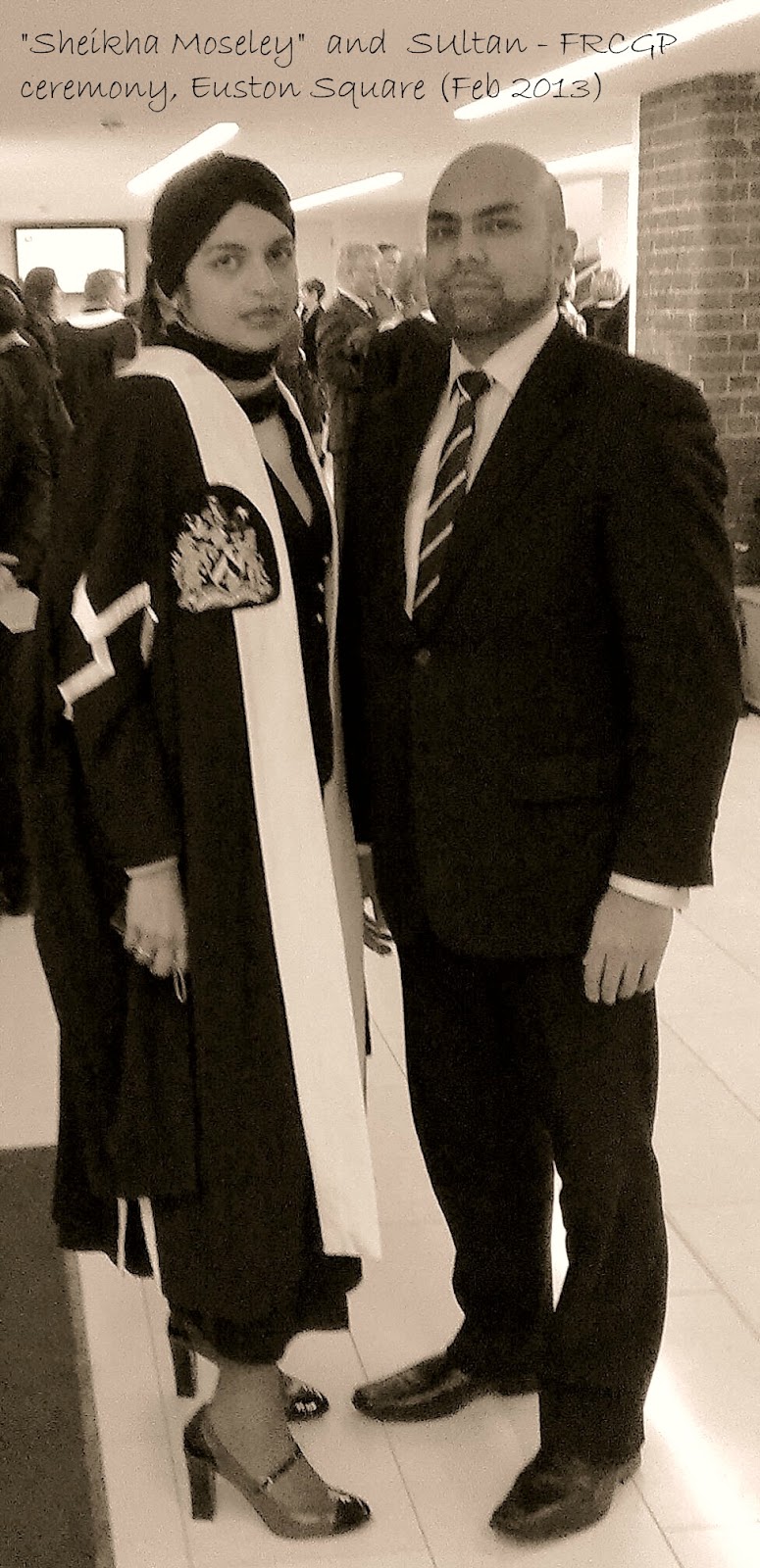
Oh, just for the record, Sheikha Mozah is the wife of the Emir of Qatar, she is an awesome and most glamorous role model ( hence the blog name). I love her style and she is a great supporter of Med Ed causes. The reason I call myself "Sheikha Moseley" is because I would love to look a good as her when I reach my 50's and I live in Moseley, Birmingham! Technically, I have no rights to call myself a Sheikha but I could call myself a Sultana ( being married to "Sultan"). Shrivelled, brown and wrinkly I don't aspire to though. Signing off from sunny Kissimmee FL.